Translate


Showing posts sorted by relevance for query erlangen heil und pflegeanstalt. Sort by date Show all posts

Tuesday, January 24, 2023

Euthanasia in the Third Reich

This article first appeared in New English Review.

Heil und Pflegeanstalt, Erlangen in 1890


Amid all the horrors of the Third Reich, including World War 2 and the Holocaust, one atrocity that is often overlooked (at least outside of Germany) was the program of euthanasia of mentally and physically handicapped people instituted by Hitler in 1939 when the war broke out. In Hitler's own terminology, these people were classified as "useless eaters". This program was referred to as "T4", named after the address of the office set up to oversee the program nationally (Tiergartenstrasse 4 in Berlin).

Under this program, patients in nursing care facilities around the country (Heil und Pflegenanstalten) were identified and their cases reviewed by doctors indoctrinated in Nazi philosophy. Once approved, these unfortunates (regardless of age) were transported to centers set up for the purpose of killing them by gas. It was sort of a dress rehearsal for the eventual gassing centers such as Auschwitz. This program also included children.

This went on without consultation with relatives of the patients, and these families were eventually notified by mail that their loved one had died in the nursing care facility of various natural causes or illnesses. The remains were generally cremated.

Yet, the public gradually became aware, and curiously enough, as complaints mounted, the Nazi government discontinued the program in 1941, but then reduced the patients' diets to the point that they gradually died of malnutrition.

While researching my book on the history of the German town of Erlangen (Erlangen: An American's History of a German Town), I became aware of the tragic history of their own Heil und Pflegeanstalt   This information was included in the chapter on the years 1933-1945.

With all that as a background, I happened to find a 2019 German YouTube documentary on the topic of the Heil und Pflegenanstalten of Ansbach and Neuendettelsau, two towns near Erlangen in Middle Franconia (Bavaria). In watching the video, I learned that many, if not most of the doomed patients in these two clinics were transferred to the facility at Erlangen before being shipped on to the infamous Hartheim Castle in Austria, which had been transformed into a euthanasia center. It is estimated that over 900 patients from Erlangen were euthanized in killing centers such as Hartheim and another 1,500 were allowed to starve to death.

Hartheim Castle in Austria


In the video, Als hätte es sie nie gegeben (As if they had never existed)there were clips of an interview with medical historian, Hans-Ludwig Siemen, as well as clips from his presentation on the topic, which took place in Erlangen. Siemen and Christine-Ruth Müller are co-authors of a book entitled, "Warum sie sterben mussten: Leidensweg und Vernichtung von Behinderten aus den Neuendettelsauer Pflegeanstalten im "Dritten Reich" (Why they had to die: Suffering and extermination of the disabled in the Neuendettelsau nursing homes in the Third Reich), published in 1991.

While watching the video, I happened to see a good friend of mine in Erlangen in the audience attending Siemen's presentation. I contacted him by email this week, and he quickly replied that indeed, it was him in the audience. With his permission, I am reposting what he emailed me:

Yes, that's me in the audience, Gary! Amazing coincidence! An act of providence really. I was there when Dr. Siemen spoke about the matter in the Volkshochschule Erlangen some years ago (before Corona). The reason is that in my mother's family, there were two physically (deaf and mute by birth) and finally probably mentally handicapped elderly women who died in the Bezirksklinikum Ansbach in the 1940s after they had been transferred from Neuendettelsau (Lutheran homes for the handicapped) to Ansbach where the Nazi physicians had total control. One of them died presumably due to the scanty "Hungerkost" diet, and the other one died in 1946, i.e. after the Nazi regime.

 I have been researching about their case in archives for years and will definitely write something about them because I feel they belong to our family although they have been more or less forgotten over the decades. Thank God both my grandmother and my mother told me frankly about them during their lifetime. I'll watch the video tomorrow in quiet. I'll touch base again with you afterward. Thanks a lot, Gary! Again I needed you to show me this. Wonderful connection!

All the best,

Helmut

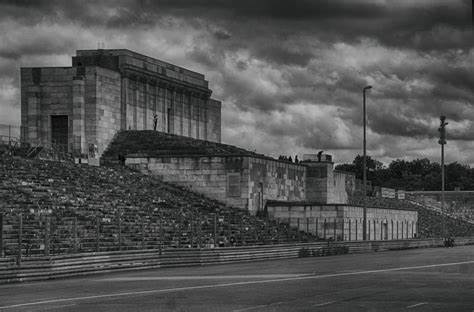
The site of the Erlangen Heil und Pflegeanstalt is now part of the University of Erlangen Psychiatric Clinic. Recently, the city of Erlangen tore down some of the old buildings, but some of it has been left standing as part of a memorial to the victims. It is one of many examples of sites related to the Nazi years that have become the subject of debate. Should they be torn down, erased, or preserved in an appropriate context so as to remind future generations of a time that must never be repeated. Just a few miles south of Erlangen, the city of Nuremberg is wrestling with what to do with the surviving (but crumbling) relics of the Nazi Party Rally grounds.


As a side note, when Erlangen fell to the US Army in 1945, a World War 1 memorial to Germany's fallen was partially torn down by the Americans. While they left standing concrete blocks with the names of Erlangen's war dead, a huge statue of a seated soldier, shirtless, with a helmet, was removed as being overly militaristic.


My personal opinion is that in the case of Germany, these sites should be preserved in some manner as a memorial to the victims. In the US, we are having a somewhat similar debate over the preservation of Civil War memorials. History, good or bad, cannot be erased. It is there. All we can try to do is put it in an appropriate context and learn from it.

Sunday, April 26, 2009

A German Town Wrestles With a Historical Site


Heil und Pflegeanstalt, Erlangen


A few years ago, I wrote a book about the town in Germany where I was stationed in the army during the late 1960s. (Erlangen-An American's History of a German Town). Naturally, part of the book covered the years of the Third Reich. Erlangen, located just a few miles north of Nuremberg, is a university town and one of the leading medical centers in Germany. Not surprisingly, much of its darkest chapters were connected to Hitler's corruption of the universities and of the medical practice. Today, part of that history has come back to the forefront as the city debates a proposal to tear down part of the old Heil und Pflegeanstalt (mental asylum).

Even before the Nazis instituted their Final Solution with the Holocaust, they engaged in what was called a dress rehearsal in the late 1930s when they began doing away with their mentally ill population. Those deemed "unworthy of life" or "useless eaters" were simply done away with through various means. Eventually, the public became aware of what was happening, and protests led to the ending of the program in 1941.

Erlangen's Heil und Pflegeanstalt, referred to locally as the Hupfla, was one of those places where patients died by the hundreds-by government design. Even after public protests led the government to end the program, hundreds continued to die at the Hupfla by simply being allowed to starve. Wilhelm Berger, a minister from a local church, did what he could to smuggle bread in to the patients with the help of a sympathetic attendant. Yet, he knew that it was far too little.

Today, a memorial to the victims stands at the entrance to the institute.

Since the 1960s, when Germany, at least West Germany (East Germany maintained they had all fought the Nazis as communists), really began to come to grips with its Nazi past, the nation has gone to great lengths to acknowledge the past and educate its younger generations so as to prevent any re-occurrence. Many of the sites associated with the Third Reich still remain. An example near Erlangen is the site of the Nazi Party Rallies in Nuremberg, which still stands though gradually crumbling. In addition, the state of Bavaria has what it calls its law for the preservation of historical monuments. Erlangen's Hupfla, which dates back to 1846, is included (Denkmalshutz).

Yet those entrusted with the preservation of historical landmarks feel that they have been by-passed in the rush to build a new research center on the site. The architectural plans for the new center would include tearing down one of Erlangen's important historical sites, both from the standpoint of its age and archectural design, as well as its historical role during the Third Reich.

The Hupfla is one of those many historical landmarks that I was totally unaware of during my time in Erlangen as an American soldier in the 1960s. Once I became aware (during my research and subsequent visits), I found the site to be a moving experience. I hope the city can find a way to keep the site, both to maintain the archectural character of the city and to maintain a site for commemmoration and reflection.

Friday, July 9, 2021

Germany: Erlangen's Former Sanitorium

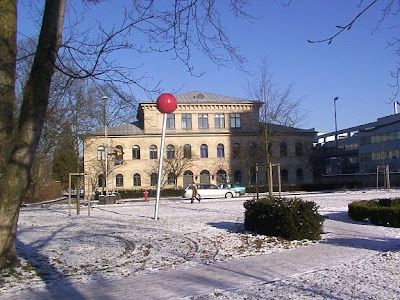
Heil und Pflegeanstalt Erlangen: The pole with the red dot in front marks it as a historical site.

Back in 2009, I wrote an article about Erlangen, the German town where I was stationed with the US Army back in the 1960s. Due to my connection to the city, I wrote an English-language history of Erlangen (Erlangen-An American's History of a German Town-2005). The article I wrote in 2009 concerned the city's quandry over what to do with their sanitorium (Heil und Pflegeanstalt-healing and nursing institute), an old structure with a long history. During a part of the Nazi era, mentally ill patients were either euthanized there or sent to larger euthanasia centers to be killed. In many cases, patients were simply allowed to starve to death.

Presently, much of the original building has been torn down. I believe part of it, the front facade has been maintained as part of the Erlangen University Clinic. The site is at least partially protected under Germany's monument protection law.

In the meantime, the state of Bavaria has appointed local points of contact for relatives or descendants of the victims who wish to learn more about the circumstances of their family members' death so long ago. I have translated an interview of the representative handling  Erlangen and vicinity (Middle Franconia), Ms. Katrin Kasparek by the Erlanger Nachrichten (Nord Bayern).

 https://www.nordbayern.de/region/erlangen/auch-fur-den-bezirk-mittelfranken-ist-ein-kunftiger-gedenkort-in-erlangen-von-bedeutung-1.11196544

Memorial for victims of National Socialist sickness murders

A memorial has meaning also for the Middle Franconia district

by Eva Kettler  July 8. 2021, 18:30 


Caption beneath photo: 

The Erlangen Sanitorium around 1890- During this time, the facility grew to 750 patients. Today, it is about the people who were in the sanitorium in the Nazi era. 

Erlangen- The Bavarian districts regularly receive inquires from relatives of former patients, who were murdered in the sanitoriums during National Socialism. The Middle Franconia district has entrusted the historian Katrin Kasparek with supporting relatives of victims of National Socialist euthanasia in the clarification of their family histories. 

Ms. Kasparek, how did you get this task with the district?

 -Two years ago, the so-called Hartheim Declaration, a memorial initiative for the victims of National Socialist "euthanasia", was formulated. The Bavarian District Assembly has joined with this declaration. With it, the districts, as representatives of the successor institutions of the former sanitoriums,  committed to appointing points of contact for the relatives. I had already been responsible for two years researching the history of the district nursing care of the Middle Franconian district under National Socialism. 

Now the district would like to have someone in me to whom people can turn with their questions about the National Socialist "euthanasia" in the district or in the district clinics. The interest tends to be growing.

Caption: Historian and social pedologist Katrin Kasparek

Which questions are asked?

Many relatives, for example, actually know that there was a family member in the institution, but they don't exactly know what actually happened. Others have an assumption because the date of death was in a (certain) time where the probability lies that it was not a natural death. The inquiries always landed till now in the district clinic administration. There, however, they could only give limited help because there are many different individual research paths that must be pursued. I am trying to help here.

What are your other tasks?

The research situation is such that in the coming years, there is still much to do. At the moment, I am researching the question of what role the predecessors of the Middle Franconian District had in the National Socialist crimes and especially the history of the Ansbach Sanitorium. 

Caption: (Erlangen) Sanitorium west wing almost completely torn down.

There is also an on-site research project on the history of the Erlangen sanitorium. The district would like, however, that beyond pure research, that there be mediation work carried out. So I am also designing events and plans for a traveling exhibition for schools, municipalities, and interested institutions for the coming year

The direct relatives are getting older and fewer, but nevertheless, the interest is increasing?

Yes, it is. I was really not conscious of that, though I have already had a lot to do with National Socialist themes and the culture of remembrance. With the relatives in the last few years, there is a kind of optimism, as following generations simply have other possibilities to open themselves emotionally to this topic. In the families, often there was nothing spoken about the people who died at that time in sanitoriums. Often it is the grandchildren or great-grandchildren, those who ask previously not allowed questions and have no fear about breaking family taboos. You can see that the emotional attitude about the topic is changing. The reservations of earlier generations are simply greater. That has something to do with the experienced stigmatization pertaining to the topic of psychiatry.

Is it also a question of people not wanting to out themselves as a relative of someone who had a mental illness?

We often read that is the reason why people don't talk about it. But I believe it is also a very natural fear of contact with the topic. Who simply walks into a psychiatric clinic? Psychiatric clinics are obviously not the places where people stay. Many people perceive them as something strange, that also causes them fear.

As a district employee, in your view, what must be given special attention in creating a place of learning and remembrance in Erlangen?

You have to ask yourself questions: Who or what do you really want to remember? Do you want to remember victims of medicine, who came from Erlangen? Do you want to illuminate the sanitorium? Or different groups of victims who came from completely different areas?

Can you explain further?

The Erlangen Sanitorium was not just a clinic for Erlangen residents, rather it had a collection area extended to Erlangen, Nuremberg, Furth, and other districts. That was, however, more of a theoretical construct.

Caption below photo: The tearing down of the sanitorium moves ahead

In practice, there were many relocations, which in the time of the Second World War, many people from Upper Franconia as well as from charitable institutions, like the Neuendettelsau Institute were sheltered in Erlangen.  The most important thing here was to fill up the sanitorium, in order to save costs.  Residents of Erlangen were also relocated to Ansbach, to fill up free spaces there. Who are we talking about when we talk about "Erlangen victims"? I think in Erlangen, in the conception of the memorial site, one of the next steps is to define, about what and about whom we want (this) to concern. And  I would be happy if the actual references which are being considered would get priority. Time after time, I see how current the topic is and how frightening close that historical events are to medical-ethical questions of the present.

What are you referring to?

For example, the current assisted death debate. The question, can we assist death from outside-and the ethical problems, which that brings. Helping someone to die medically, who cannot do it himself-that brings us to the fundamental issues of eugenics. Another example is pre-natal diagnostics- all topics that have great relevance for the present and the future.


r

Friday, August 16, 2024

Germany: Erlangen Remembers its Victims From the Euthanasia Program (T-4)

Erlangen Heil und Pflegeanstalt
Erlangen Sanatorium and Nursing Home


From time to time, I have posted articles or translations concerning Erlangen, Germany, the town outside Nuremberg where I spent my military service time, 1966-68. Mostly, the articles concern Erlangen's history during the Third Reich and how the town commemorates that dark period. In that vein, I have previously written about the Erlangen Sanatorium and Nursing Home (HuPfla) and its role in the euthanasia (murder) of almost 3,500 sick or mentally handicapped patients during the years, 1940-41. This was part of the Aktion T-4, named after the address of the building where the planning and direction of this program were carried out (Tiergartenstrasse 4, Berlin). The purpose of this action was to rid Germany of those who were mentally disabled, physically deformed, or considered as "life unworthy of life" or "useless eaters".

In recent years, the Erlangen Sanatorium has been largely torn down to make room for more modern health centers. Due to a long debate about maintaining historical monuments, part of the center has been left standing in commemoration of the victims.


A more recent photo. The red dot signifies a historical site.


Much of this is described in my own history of Erlangen, "Erlangen-an American's history of a German town" (University Press of America, 2005).

Below is a translation of an article in the Erlanger Nachrichten which is translated by Fousesquawk.

-Erlanger Nachrichten


Exhibition at the savings bank

Memory of dark times: Exhibition of "Grey buses" in Erlangen focuses on Nazi euthanasia 

August 15, 2024 at 13:26

 Caption: The artists, Andreas Knitz and Horst Hoheisel,  created the "Memorial to the grey buses" out of concrete. It is to remember the transport with grey-painted buses, which on the orders of the Nazis, transported people to the killing centers. (Inscription: "Where are you taking us?" 1940-41.)

Erlangen- Since February 6 on the Huguenottenplatz, a concrete bus commemorates the victims of the Nazi murders of the sick from Erlangen. The accompanying exhibition in the savings bank can be seen till September 6 and illustrates the terrible transports.

A concrete bus commemorates the victims of the Nazi murders of the sick, among others, from the Erlangen Sanatorium and Nursing Center. In order to remember the Nazi euthanasia crimes, the artists, Horst Hoheisel and Andres Knitz, have recreated the autobuses, in which the patients were taken to killing centers as part of Action T-4. Since 2007, such a bus stands permanently in front of the former Ravensburg-Weissenau Sanatorium in Baden-Wuerttemberg. A second bus changes its location and has has been already viewed in 19 locations in Germany. What they symbolize is that in the years 1940-41, buses were driving through the country, visible to all, and picking up people and taking them to their murders.

905 people taken from the (HuPfla) Sanatorium and Nursing Home and killed

905 patients were taken from the Erlangen Sanatorium and Nursing Home-mostly by train- and murdered at the Pirna-Sonnenstein and Hartheim (near Linz) killing centers. In addition, in Erlangen, between 1939 and 1945, over 1,900 patients died, including some 700 as a direct or indirect result of malnourishment and structural neglect. With the temporary erection of the memorial till the end of 2024, the city of Erlangen remembers the victims.

Currently, a comprehensive concept for a site for remembrance and the future in Erlangen is being worked out by the Friedrich-Alexander University Erlangen-Nuremberg and the city of Erlangen. The art activity in Erlangen will be accompanied by events focusing on the theme of the Nazi euthanasia, and will report on further development of memorial sites in Erlangen. That also includes the traveling exhibition, "Memorial to the grey buses" designed by the artists Hoheisel and Knitz, which (describes) the historical background and the various sites.