
British member of the European Parliament, Nigel Farage, gave the what for to his sullen colleagues yet again in Strasbourg this June with this masterpiece on the Euro bailout for Spain. Enjoy.
Wednesday, July 25, 2012

Louise Lucas, Truth and Race Politics
Louise Lucas (D) is a Virginia state senator from Portsmouth, who is also part of of what President Obama calls his "Truth Team". (I get e-mails from them all the time. I'm still waiting for the truth part.) Interviewed on a local radio show this week, Ms Lucas had this to say about Mitt Romney. (You have to go past the 2-minute mark to hear her tell the interviewer that Romney appeals to people who don't like black people-especially black presidents or something like that.)
Hope and change, truth and a post-racial president
Here is what I think is appropriate. I think it would be appropriate for President Obama to publicly denounce these comments and have Ms Lucas removed from the so-called Truth Team. Then, perhaps, he can still claim to be president of all the people.
Smile, Maxine Waters: You Are on Candid Camera
"C'mon, Maxine."
Fox Nation and Breitbart TV have picked up the speech Maxine Waters made on February 19, 2012 at the town hall at the Islamic Center of Orange County, which was just recently posted here.
http://nation.foxnews.com/maxine-waters/2012/07/24/rep-maxine-waters-voting-against-sharia-law-gop-fear-mongering-and-bigotry
The Sinking of the California *

It was an unseasonably mild day in April as the Titanic sailed across the South Pacific en route to the US. Captain Edward Smith was standing on the bridge looking out for icebergs when his aide rushed up to him with an e-mail message in his hand.

"Captain", said the mate breathlessly. "We just got word from the California. They have sent out an SOS. They are sinking fast!
"The California," exclaimed Smith. "That's Jerry Brown's ship. We went to the seminary together. Alert the engine room. Full speed ahead. We must save the California!"

Captain Jerry Brown
Meanwhile, 100 nautical miles away, Captain Jerry Brown stood on the bridge at a 45 degree angle. All hope was lost for the California. There was only one thing to do-abandon ship.
"Man the lifeboats", he ordered.
There was just one problem. There weren't nearly enough lifeboats to save all the passengers, and Captain Brown knew it.
As panicked passengers crowded the deck, ships' hands stood guard and tried to bring order to the process of getting people into the life boats. There would be a strict priority.
"Captain, crew, politicians, union bosses, and ships' hands first", they ordered. One by one, people in uniform showed their ID or union card before being lifted into the lifeboats as the unfortunate ones shuffled back to await their fate.
Several hours later, the Titanic arrived at the scene of the distress call. There was no California. Fortunately, however, they were able to spot several lifeboats floating among the debris. Captain Brown was the first one saved followed by various other crew members, politicians, union bosses and others fortunate enough to have brought their union cards with them. Among the more notable survivors were Lt. Governor Gavin Newsom and Los Angeles Mayor Antonio Villaraigosa.
After the Titanic docked in Las Vegas, there was a board of inquiry, of course. Heading the investigation was none other than the Inspector General of the US Justice Department. Captain Brown was quickly cleared of any responsibility for the disaster, which was blamed on lack of revenue due to the wealthiest 1% of tax-payers not paying their fair share.
Brown has gone on to bigger things and is rumored to be thinking of running for president. It is predicted that Newsom and Villaraigosa will compete for the governorship of Nevada since there is no more California.
* For all you UC Santa Cruz Community Studies and History of Consciousness majors, the California was the vessel that received the distress call from the Titanic and picked up survivors.

Obama Says He Was Taken "Out of Context"
Hat tip PJ Media

The Obama campaign is having a hard time dealing with the president's comment in Roanoke last week telling business owners, "You didn't build that". Now Obama has come out with an ad claiming he was taken out of context. PJ Media examines what he said.
http://pjmedia.com/tatler/2012/07/24/obama-throws-himself-and-liz-warren-under-the-bus/
The Obama campaign is having a hard time dealing with the president's comment in Roanoke last week telling business owners, "You didn't build that". Now Obama has come out with an ad claiming he was taken out of context. PJ Media examines what he said.
http://pjmedia.com/tatler/2012/07/24/obama-throws-himself-and-liz-warren-under-the-bus/
"There are a lot of wealthy, successful Americans who agree with me — because they want to give something back. They know they didn’t — look, if you’ve been successful, you didn’t get there on your own. You didn’t get there on your own. I’m always struck by people who think, well, it must be because I was just so smart. There are a lot of smart people out there. It must be because I worked harder than everybody else. Let me tell you something — there are a whole bunch of hardworking people out there. (Applause.)
If you were successful, somebody along the line gave you some help. There was a great teacher somewhere in your life. Somebody helped to create this unbelievable American system that we have that allowed you to thrive. Somebody invested in roads and bridges. If you’ve got a business — you didn’t build that. Somebody else made that happen. The Internet didn’t get invented on its own. Government research created the Internet so that all the companies could make money off the Internet." (Roanoke).
Ad:
OBAMA: "What I said was, we need to stand behind them, as America always has, by investing in education and training, roads and bridges."

"That's not what I said."
What I don't get is how Elizabeth "Little White Dove"Warren plays into this. What line did Obama steal from her-something about being 1/32nd Cherokee?
 (Note the high cheekbones)
He could always play that Anna Wintour ad, I guess.
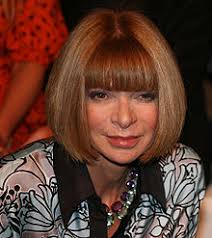
"Very funny."
Ad:
OBAMA: "What I said was, we need to stand behind them, as America always has, by investing in education and training, roads and bridges."
"That's not what I said."
What I don't get is how Elizabeth "Little White Dove"Warren plays into this. What line did Obama steal from her-something about being 1/32nd Cherokee?
 (Note the high cheekbones)
He could always play that Anna Wintour ad, I guess.
Tuesday, July 24, 2012
So What Did You Mean, Sen. Feinstein?

It was predicable. No sooner did Senator Diane Feinstein state that she believed that national security leaks were coming out of the White House, she now "clarifies" those remarks.
http://www.foxnews.com/politics/2012/07/24/senate-intelligence-committee-head-regrets-speculating-about-leaks/
Thanks for clearing that up, Senator Feinstein.
"Don't mention it."
The Brussels Declaration
A few days ago, I posted a couple of articles on a conference in Brussels last week in defense of civil liberties. The result of this conference is what is called the Brussels Declaration. It is a response to the Istanbul Process and the Cairo Declaration on Human Rights.
http://www.libertiesalliance.org/brusselsconference/2012-brussels-declaration/
By all means, read and research the Istanbul Process and the Cairo Declaration. Then decide which of the three you prefer.
http://www.libertiesalliance.org/brusselsconference/2012-brussels-declaration/
By all means, read and research the Istanbul Process and the Cairo Declaration. Then decide which of the three you prefer.
More Textbook Controversy
Hat tip to Al Rowley, a local activist, who sent me this article.


A couple of years ago, based on a complaint made to me by a teaching colleague who had two sons exposed to textbooks in a local Irvine, California school, I wrote a posting on a textbook that is making the rounds around the country for 7th grade students. It is called "History Alive- The Medieval World and Beyond. Publisher: Teachers Curriculum Institute."
http://garyfouse.blogspot.com/2010/05/what-are-our-kids-being-taught-at.html
This book has aroused the ire of parents in other locales as well. Now Stephen Schwartz has written a critical article in the Weekly Standard about this same textbook.
Note: Before you assume Mr Schwartz is an "Islamophobe", you should know that he is a convert to Sufist Islam. He has a website (linked on Fousesquawk) entitled, "Center for Islamic Pluralism". Yet he is fully aware of the problems, and not afraid to speak out on them.
---------------------------------------------------------------------------------------------------------
The worst textbook ever when it comes to teaching about Islam.
Stephen Schwartz
August 9, 2010, Vol. 15, No. 44
"The state of California, a major player in the American textbook market, introduces its students to Islam in the seventh grade. For this purpose, the California State Board of Education has recommended the use of, among others, a world history textbook entitled History Alive! The Medieval World and Beyond, issued by the Teachers’ Curriculum Institute of Palo Alto. A review of the 2005 edition of this book (first published in 2004) provides a dismaying example of what has been, and in some states continues to be, wrong with public school teaching about Islam.
Not to put too fine a point on it, in these pages the history and beliefs of Islam receive special treatment accorded no other religion. This curious emphasis and flattery deserve scrutiny at a time when the three states that dominate the textbook market—California, Texas, and Florida—are officially in the process of reviewing learning standards and content for new textbooks, to be printed in 2011-13. California, however, has suspended its review process for lack of funds, which means that the standards used in producing this volume remain in force, and the textbook remains authorized for public schools. Today, given the challenge of radical Islam to the American system of liberties and the persistent conflicts involving Israel in the Middle East, what American youths are taught about Islam, and about relations between Muslims, Christians, and Jews, is of singular importance.
History Alive! The Medieval World and Beyond has already elicited harsh comments from textbook critics. William J. Bennetta, editor of the Textbook Letter and president of the Textbook League, is an energetic monitorof falsifications and distortions in authorized teaching materials. His work has been praised by education expert Diane Ravitch. Bennetta has called the volume under review “corrupt” and “pseudohistorical,” warning that it imparts a “vividly sectarian, vividly promotional” attitude toward Islam amounting to “illegal religious indoctrination.” A fresh and objective look at the book confirms Bennetta’s judgment of its content. But before proceeding to document that, we should note that the volume also exemplifies the current view of education and textbooks as “edutainment,” framed to compete with popular culture for the attention of students. Edutainment products are like movies: When their messages are not straightforward, the underlying biases, distortions, errors, and gaps must be understood by inference.
History Alive! The Medieval World and Beyond covers world history from the fall of Rome to the Enlightenment. Quite properly, the book gives most space to Western history and culture as the principal source of American civilization. Fourteen of its 35 chapters address the legacy of Rome, European feudalism, the growth of towns, the Byzantine Empire, the Renaissance, the Reformation, the age of exploration, and the scientific revolution. Other units treat the culture and kingdoms of West Africa (4 chapters), imperial China (4 chapters), medieval Japan (3 chapters), and the pre-Columbian civilizations of the Americas (5 chapters). What will detain us here, however, is the unit on “The Rise of Islam,” noteworthy because it provides several varieties of detail no other strand of world history receives. Its 5 chapters cover the geography of Arabia, the life of the religion’s founder, the teachings of Islam, the contributions of Muslims to world civilization, and the Crusades and the Spanish reconquest. Remarkably for a book of medieval history, these pages include seven photographs of Muslims engaged in religious observance today, strongly hinting at its real agenda: to depict Islam as unchanging over time, in line with the beliefs and aims of Islamist ideologues.
Although this textbook contains plenty of maps, the only portion of the globe whose geography is the subject of an entire chapter, intended for one week’s study, is the Arabian Peninsula. This establishes from the outset the Arabocentric focus of the textbook’s presentation of Islam. A preface to the unit on Islam entitled “Setting the Stage” concedes that “today Arabs are a small minority of Muslims worldwide.” Nevertheless, the text insistently depicts Arabia as the central reference point for Islam. Arab Christianity is absent, even though ancient Christian communities existed throughout the period under study and survive to this day in Arab lands including Egypt, Lebanon, and Iraq. While the Persians and the Turks, the Indians and the Southeast Asians, receive passing mentions, none of these Islamic civilizations rates a chapter or even a subhead. All this reinforces the sense that Islam is “the Arab religion.”
“The influence of Arabia became far more powerful with the rise of Islam,” we learn. “From its central location in Arabia, Islam spread rapidly throughout the Middle East, North Africa, and parts of Europe. Great cities like Cordoba in Spain, Cairo in Egypt, and Baghdad in present-day Iraq became important centers of the Islamic world.” The impression is left that the global Islamic community was directed from Arabia, when in reality the Muslim lands, soon after the death of Muhammad, divided into competing domains. Neither Cordoba nor Cairo nor Baghdad in its period of greatest power and influence was ever politically subordinate to Arabia. The chapter summary repeats the aggrandizement of Arabia in world history, stating, “Arabia and nearby lands are at the crossroads of Asia, Africa, and Europe.” But Arabia did not have close relations with Europe until the 20th century and the growth of energy income.
More remarkable than the singling out of the Arabian Peninsula for this exceptional treatment is the similar honor accorded one individual: The Prophet Muhammad is the only person whose life and influence merit a full chapter in this book. Indeed, Muhammad is the only individual so much as named in a chapter title. History Alive! The Medieval World and Beyond offers no age of Justinian or Charlemagne, Dante or Shakespeare, Columbus or Elizabeth, Luther or Newton or Locke. More to the point, perhaps, it contains no chapter—no paragraph even—on the life of Jesus, although the founder of Christianity is at least as consequential a figure in world history as the founder of Islam—far more so for American civilization—and his life falls within the scope of the introductory chapter on the legacy of Rome. For that matter, even so elementary a point of information as that Jesus’ birth is the hinge event dividing the Western calendar is not taught in this book—though pupils do learn, in the course of their weeklong study of the life of the prophet, that “the year of Muhammad’s hijrah [flight from Mecca to Medina] later became the first year in the Muslim calendar.”
A few times in the chapter on Muhammad, the qualifying phrase “according to Islamic teachings” prefaces an assertion; for the most part, however, the biography of the prophet is presented as history. The student is never informed that for Muslims the portrayal of Muhammad is a component of faith rather than contemporaneously attested fact. Again the contrast with the treatment of Christianity is sharp: The sole sentence on the life of Jesus reads, “Christians are followers of Jesus, who, according to Christian Scripture, was put to death on a Roman cross in the first century c.e.” What’s more, even the delineation of Muhammad’s life is selective. The text mentions Muhammad’s first wife, Khadijah, for instance, but leaves out the 10 or so other wives he married after her death—even his favorite, Aisha—as well as his concubines.
The discussion of the extension of Islamic power during and after Muhammad’s life is among the parts of the textbook most open to criticism for its often euphemistic wording. While “armies” and “conquests” are mentioned, the section skips over battles led by Muhammad himself, which are a major element of Islam’s foundational narrative. There is one reference to a Muslim raid on a caravan, but this hint of military activities by the early Muslims is followed by the benign comment, “Muhammad convinced other tribes to join the Muslim community.”
The last section of the chapter discusses in generally reassuring terms Muhammad’s successors and the building of the Muslim empire.
When some tribes tried to break away, Abu Bakr used military campaigns to reunite the community. Under his leadership, Muslims completed the unification of Arabia. Then they began to carry the teachings of Islam beyond the Arabian Peninsula. After Abu Bakr died in 634 c.e., Caliph Umar expanded the Muslim empire. In addition to spreading the faith of Islam, conquest allowed Muslims to gain new lands, resources, and goods.
The acceptance of Ali as the fourth successor to Muhammad is mentioned, along with the war launched against him by the Umayyads, adherents of Caliph Uthman, and Ali’s assassination. Even so, the split in Islam between the Sunnis (who submitted to the rule of the Umayyads) and the Shias (who supported Ali’s descendants) is dealt with sketchily, though this division within Islam is relevant to such important present-day phenomena as the radical Islamist regime in Iran and sectarian conflict in Iraq.
And the Arabocentrism continues: “Slowly, the lands of the Muslim empire took on more elements of Arab culture. Muslims introduced the Arabic language. Along with Islam, acceptance of Arabic helped unite the diverse people of the empire.” References to the Persian role in the development of Islamic civilization are few and perfunctory. The pupil would scarcely divine that the Islamization of Persia—once a leading ancient empire—did not result in the Arabization of its extensive and expansive culture. Rather, it fostered the emergence of a distinctive Islamic tradition, one of several. The Persian language became a medium for Muslim religious scholarship equal in status to Arabic. And Persian rather than Arab Islam was spread through Central Asia, among Turkic peoples, and penetrated the Indian subcontinent. Islamic consolidation did not survive the divisions and rivalries within the Muslim dominions beginning with the death of Caliph Ali. These elements of discord and competition are no less important than those represented by the split between Rome and Byzantium described in an earlier chapter, but the authors of this textbook do not give them an equally full discussion.
Islamic history is controversial not only among critics of the faith and of religion in general, but also among Muslims. To remove the contested elements of Islam’s origins—above all the prevalence of war in early Islam and the substance of the Sunni-Shia division—from a textbook approved for use by American 7th graders implies indoctrination in a specific sectarian view, the radical Islamist view. This seemingly bland but intellectually distorted presentation is epitomized in the chapter summary, which states that Muhammad “taught equality. He told his followers to share their wealth and to care for the less fortunate in society. He preached tolerance for Christians and Jews as fellow worshipers of the one true God.” This laudatory perspective—coming after a portrayal of medieval Christendom devoid of any reference to the teachings of Jesus but diligent in describing inequality, poverty, superstition, and religious persecution—skews history to present the Prophet Muhammad as the unique moral hero of the medieval world. The textbook also removes from consideration the reality that, notwithstanding the principles of Islam, Muslim societies have been (and continue to be) known for social inequality, neglect of the poor, and intolerance.
Much more objectionable material is on display in the chapter entitled “The Teachings of Islam.” The prefatory section states,
If you visited any city [emphasis added] in a Muslim country today, you would notice many things that reflect the teachings of Islam. Five times a day, you would hear a call to prayer throughout the city. While some people hurry to houses of worship, called mosques, others simply remain where they are to pray, even in the street. You would see people dressed modestly, and many women wearing a head scarf. You would find that Muslims do not drink alcohol or eat pork. You might learn how Muslims give money to support their houses of worship and many charitable works. Soon you would come to understand that Islam is practiced as a complete way of life.
Apart from being out of place in a work of medieval history, this passage encapsulates a fundamentalist view of Islam. In many Muslim-majority cities in Morocco, Algeria, Tunisia, the Balkans, Turkey, Central Asia, Russia, the Indian subcontinent, and Southeast Asia, among other countries and regions, the call to prayer is frequently ignored, people seldom, if ever, pray in the street, women wear Western-style dress, and numerous Muslims drink alcohol. (Consumption of pork is generally unknown because of limits on farming of pigs and sale of their meat, which are easier to enforce than regulations against alcohol.) Mosques today are more often supported by state financing than, as in the past, by charitable donations.
Above all, the repeated claim that “Islam is practiced as a complete way of life” is a declaration of radical Islam, not a description of reality. Islam, like other world religions, includes wide variations in attitude and practice. These encompass the jihadism of Osama bin Laden; the rigid fanaticism of Saudi Wahhabis and Iran-backed clericalists, who insist on control over the individual’s “complete way of life”; the humanistic spirituality of the Sufis; and the secularism of Muslims who embrace universal principles of individual freedom and respect for others. Millions of Muslims who are largely indifferent to the observance of religious rituals are still considered believers by traditional Islamic authorities.
The chapter goes on to introduce the Five Pillars of Islam—the declaration of faith, prayer, charity, fasting, and the pilgrimage to Mecca. To these it adds the Koran and the Sunnah (the example set by Muhammad); jihad, defined as “Muslims’ struggle with internal and external challenges as they strive to please God”; and sharia, Islamic law. A large eight-pointed diagram on the first page of the chapter shows the Five Pillars joined to jihad, sharia, and the Koran and the Sunnah. The message is obvious: Jihad and sharia are equal in standing to the Five Pillars and the Koran and Sunnah as essential components of Islam. This projection conflicts with the reality of Islam today but faithfully reproduces the arguments of Islamist ideology.
Each of these points of doctrine or practice then receives a detailed exposition, always in tune with Islamist indoctrination. We read, for instance, “The Koran holds a central position for Muslims everywhere, guiding them in all aspects of their lives.” But this is, to emphasize, false. Many Muslims in many countries treat Islam as a personal spiritual matter and are guided in other aspects of their lives by secular law and local custom. Koranic totalism about daily life is a marker of fundamentalism, not Islam in general. The doctrine that Islam dictates every aspect of experience sets the Muslim against the world in which he lives and puts him directly on the road to radicalism.
Similarly, students read that “fasting teaches Muslims self-control and makes them realize what it would be like to be poor and hungry.” It would be more honest and useful in the education of Americans to admit that poverty and hunger are widespread in the Muslim world.
The section on jihad is predictably one of the worst in History Alive! The Medieval World and Beyond. It begins, “The word jihad means ‘to strive.’ Originally in Islam, it meant physical struggle with spiritual significance.” Note the deliberate slipperiness of this phrasing—it as much as admits that jihad refers to religious war, yet it could just as well describe martial arts instruction. The fastidious use of language continues: “The Koran tells Muslims to fight to protect themselves from those who would do them harm or to right a terrible wrong. Early Muslims considered their efforts to protect their territory and extend their rule over other regions to be a form of jihad.”
Put plainly, Muslims waged jihad to conquer new territory and spread their religion. Of immediate relevance to American students is the fact that Muslim radicals today, like those who flew planes into the World Trade Center, justify terrorist acts as jihad. Yet the textbook insists on an ameliorative treatment of this important and contentious topic. It states on the same page that Muslims who are engaged in jihad
might work to become better people, reform society, or correct injustice. . . . Muslims should fulfill jihad with the heart, tongue, and hand. Muslims use the heart in their struggle to resist evil. The tongue may convince others to take up worthy causes, such as funding medical research. Hands may perform good works and correct wrongs.
But American students need to know that, in addition to these, there has always been a military interpretation of jihad. Today, Muslim extremists claim to reform society, correct injustice, resist evil, and correct wrongs by unrestrained violence including terrorism targeting civilians, both Muslim and non-Muslim alike.
The section on Islamic law similarly adopts a sanitized vocabulary. Omitted is any mention of Muslim practices offensive to most present-day Westerners, such as poly-gamy, forced marriage, forced divorce, public beheadings, and judicial punishments such as amputations, cruel floggings, and stonings, even though these are regularly imposed as sharia penalties in, most notably, the kingdom of Saudi Arabia, allegedly the world’s Islamic leader and ideal.
In the matter of clothing, students are informed that “Muslim women usually wear different forms of modest dress. Most women cover their arms and legs. Many also wear scarves over the hair.” The millions of Muslim women who dress in Western styles and do not affect head coverings are written out of the narrative, just as extremists seek to exclude such women from the Muslim community. That Muslim women in full face or body coverings are a minority within the religion goes unmentioned. That sharia interpretations in Saudi Arabia and Iran mandate punishment for women who do not obey fundamentalist dress codes is also ignored. To the extent that contemporary customs have any place at all in a textbook of medieval history, these are issues in the lives of Muslim women about which American students need to be informed.
Before leaving the subject of Islamic teachings, I must stress that no other religion receives anything like equal time in this book. The chapter on the role of the church in medieval Europe does state, after the sentence quoted earlier about Jesus’ death, “Christians believe that Jesus was the son of God, that God sent him to Earth to save people from their sins, and that he rose from the dead after his crucifixion.” And two pages later, a chart displays the seven sacraments of the Roman Catholic Church, explained as “sacred rites that Christians believed brought them grace, or a special blessing from God.” But the thrust of the chapter is institutional and cultural, with sections on pilgrimages and monasticism and the great cathedrals.
The two chapters on the Reformation are somewhat more informative about Christian teachings. The Protestant reformers’ insistence on making the Bible available to ordinary people in their own languages (rather than the original Hebrew and Greek or in Latin translation, accessible only to priests and scholars) is reported, as is their insistence on the Bible as the ultimate authority in religion and Jesus as the true head of the church. Even the reformers’ doctrines of salvation by grace, justification by faith, and predestination are touched on. Yet the contents of the Bible, Jewish and Christian, are never described. The student—having studied each of the Five Pillars of Islam in detail and learned how the angel Gabriel revealed messages to Muhammad over the course of 22 years that were “imprinted on his mind and heart” and memorized by his followers and eventually collected into the Koran—is left in pristine ignorance of what the Bible is and contains. He will study this book’s account of 1,200 years of Western experience without ever so much as hearing of Genesis, Exodus, or the prophets, the psalms or the proverbs, Job or the Song of Songs, the epistles or Revelation. The lone mention of the “gospels that tell of the life and teachings of Jesus” comes in the chapter on the teachings of Islam.
he last chapter of the unit on Islam is entitled “From the Crusades to New Muslim Empires.” In a concession to the inconsistent character of Muslim rule over people of other religions, it acknowledges that, “depending on the policies of various Muslim rulers … non-Muslims’ rights and freedoms varied from time to time. Some Muslim rulers allowed the destruction of important Christian churches.” This and other references hint at the motive for the First Crusade—recovery, after four centuries of Islamic rule, of Jerusalem, the ancient Jewish capital where Jesus preached and was persecuted. Considering that the text has previously left out any mention of Muslim mistreatment of Jews or Christians, to say nothing of other non-Muslims—and has instead repeatedly asserted that Islam respects Jews and Christians—this minor admission is so nebulous as to be meaningless. A section on “Jews and the Crusades” is the first extensive (half-page) discussion of Jews in the book. The sole intent of the section, which recounts the attacks on Jews that accompanied the First Crusade and the ghettoization of European Jews in the later Middle Ages, is apparently to portray Christians negatively and Jews as victims.
Why would the state of California approve a textbook that affords special treatment to Islam? One might hazard that when the California standards that resulted in this wretched volume were put forward—in the late 1990s, before 9/11—state authorities saw Muslims as yet another constituent group to be catered to under the official policy of multiculturalism. But the subtextual motive in History Alive! The Medieval World and Beyond is not just to improve the self-esteem of minority students, the usually advertised goal of multiculturalism in schools. More important, there is the need to accommodate powerful ethnic lobbies. This is the obvious explanation for the inclusion in this volume of a three-chapter unit on Japan—in a state where the descendants of Japanese immigrants are seen as a political minority—but no discussion of India or of the Celtic and Slavic cultures that flourished in the Middle Ages. The ethnic lobbies, acting through their influence on elected officials, academic “educators,” and public-employee unions, have achieved a monopoly over the content of textbooks, successfully pressing for the adoption of their favored items.
Among the most powerful of these lobbies are the Arab-inspired, Saudi-created entities that decades ago seized public leadership of Muslims in the United States. In 2005, California curriculum authorities proudly cited their use of guidelines provided by the radical fundamentalist Islamic Society of North America (ISNA, a darling of the Obama administration) and the Council on Islamic Education (CIE) in drawing up a framework for the treatment of religion in public schools.
This review of History Alive! The Medieval World and Beyond makes no claim to be exhaustive—far from it. Close examination would yield many more examples of bias. The discussions of Islamic intellectual contributions and the spread of Islam in Central Asia and West Africa, for instance, are conspicuously problematic. But the evidence offered here should be sufficient to sustain the obvious conclusion.
The book advances a fundamentalist Islamist agenda that erases from consideration conflicts within Islam from Muhammad onward that are relevant to understanding Islam in the past and Islam today, including its radical, aggressive variant. This book is not history. It is, instead, an example of sectarian and ethnic favoritism, indeed, of cultural discrimination, separatism, and propaganda for Islamic supremacy, which California and the other states that have adopted it should repudiate."
Stephen Schwartz is the author of The Two Faces of Islam: The House of Saud from Tradition to Terror and The Other Islam: Sufism and the Road to Global Harmony.
------------------------------------------------------------------------------------------------------------
I should state that I am not advocating that public schools and textbooks demonize Islam or do anything that would cause harm to Muslim children attending school. At the same time, I am concerned that our institutions of learning are so dedicated to political correctness that they are actively teaching our children information that is not only misleading, but factually false.
The state of California has the most politically-correct guidelines in the nation. Textbook publishers know this. If they want their books used in California, they have to tread the politically-correct line, Does that not affect the books that children are reading all across the nations? You bet it does.

A couple of years ago, based on a complaint made to me by a teaching colleague who had two sons exposed to textbooks in a local Irvine, California school, I wrote a posting on a textbook that is making the rounds around the country for 7th grade students. It is called "History Alive- The Medieval World and Beyond. Publisher: Teachers Curriculum Institute."
http://garyfouse.blogspot.com/2010/05/what-are-our-kids-being-taught-at.html
This book has aroused the ire of parents in other locales as well. Now Stephen Schwartz has written a critical article in the Weekly Standard about this same textbook.
Note: Before you assume Mr Schwartz is an "Islamophobe", you should know that he is a convert to Sufist Islam. He has a website (linked on Fousesquawk) entitled, "Center for Islamic Pluralism". Yet he is fully aware of the problems, and not afraid to speak out on them.
---------------------------------------------------------------------------------------------------------
The worst textbook ever when it comes to teaching about Islam.
Stephen Schwartz
August 9, 2010, Vol. 15, No. 44
"The state of California, a major player in the American textbook market, introduces its students to Islam in the seventh grade. For this purpose, the California State Board of Education has recommended the use of, among others, a world history textbook entitled History Alive! The Medieval World and Beyond, issued by the Teachers’ Curriculum Institute of Palo Alto. A review of the 2005 edition of this book (first published in 2004) provides a dismaying example of what has been, and in some states continues to be, wrong with public school teaching about Islam.
Not to put too fine a point on it, in these pages the history and beliefs of Islam receive special treatment accorded no other religion. This curious emphasis and flattery deserve scrutiny at a time when the three states that dominate the textbook market—California, Texas, and Florida—are officially in the process of reviewing learning standards and content for new textbooks, to be printed in 2011-13. California, however, has suspended its review process for lack of funds, which means that the standards used in producing this volume remain in force, and the textbook remains authorized for public schools. Today, given the challenge of radical Islam to the American system of liberties and the persistent conflicts involving Israel in the Middle East, what American youths are taught about Islam, and about relations between Muslims, Christians, and Jews, is of singular importance.
History Alive! The Medieval World and Beyond has already elicited harsh comments from textbook critics. William J. Bennetta, editor of the Textbook Letter and president of the Textbook League, is an energetic monitorof falsifications and distortions in authorized teaching materials. His work has been praised by education expert Diane Ravitch. Bennetta has called the volume under review “corrupt” and “pseudohistorical,” warning that it imparts a “vividly sectarian, vividly promotional” attitude toward Islam amounting to “illegal religious indoctrination.” A fresh and objective look at the book confirms Bennetta’s judgment of its content. But before proceeding to document that, we should note that the volume also exemplifies the current view of education and textbooks as “edutainment,” framed to compete with popular culture for the attention of students. Edutainment products are like movies: When their messages are not straightforward, the underlying biases, distortions, errors, and gaps must be understood by inference.
History Alive! The Medieval World and Beyond covers world history from the fall of Rome to the Enlightenment. Quite properly, the book gives most space to Western history and culture as the principal source of American civilization. Fourteen of its 35 chapters address the legacy of Rome, European feudalism, the growth of towns, the Byzantine Empire, the Renaissance, the Reformation, the age of exploration, and the scientific revolution. Other units treat the culture and kingdoms of West Africa (4 chapters), imperial China (4 chapters), medieval Japan (3 chapters), and the pre-Columbian civilizations of the Americas (5 chapters). What will detain us here, however, is the unit on “The Rise of Islam,” noteworthy because it provides several varieties of detail no other strand of world history receives. Its 5 chapters cover the geography of Arabia, the life of the religion’s founder, the teachings of Islam, the contributions of Muslims to world civilization, and the Crusades and the Spanish reconquest. Remarkably for a book of medieval history, these pages include seven photographs of Muslims engaged in religious observance today, strongly hinting at its real agenda: to depict Islam as unchanging over time, in line with the beliefs and aims of Islamist ideologues.
Although this textbook contains plenty of maps, the only portion of the globe whose geography is the subject of an entire chapter, intended for one week’s study, is the Arabian Peninsula. This establishes from the outset the Arabocentric focus of the textbook’s presentation of Islam. A preface to the unit on Islam entitled “Setting the Stage” concedes that “today Arabs are a small minority of Muslims worldwide.” Nevertheless, the text insistently depicts Arabia as the central reference point for Islam. Arab Christianity is absent, even though ancient Christian communities existed throughout the period under study and survive to this day in Arab lands including Egypt, Lebanon, and Iraq. While the Persians and the Turks, the Indians and the Southeast Asians, receive passing mentions, none of these Islamic civilizations rates a chapter or even a subhead. All this reinforces the sense that Islam is “the Arab religion.”
“The influence of Arabia became far more powerful with the rise of Islam,” we learn. “From its central location in Arabia, Islam spread rapidly throughout the Middle East, North Africa, and parts of Europe. Great cities like Cordoba in Spain, Cairo in Egypt, and Baghdad in present-day Iraq became important centers of the Islamic world.” The impression is left that the global Islamic community was directed from Arabia, when in reality the Muslim lands, soon after the death of Muhammad, divided into competing domains. Neither Cordoba nor Cairo nor Baghdad in its period of greatest power and influence was ever politically subordinate to Arabia. The chapter summary repeats the aggrandizement of Arabia in world history, stating, “Arabia and nearby lands are at the crossroads of Asia, Africa, and Europe.” But Arabia did not have close relations with Europe until the 20th century and the growth of energy income.
More remarkable than the singling out of the Arabian Peninsula for this exceptional treatment is the similar honor accorded one individual: The Prophet Muhammad is the only person whose life and influence merit a full chapter in this book. Indeed, Muhammad is the only individual so much as named in a chapter title. History Alive! The Medieval World and Beyond offers no age of Justinian or Charlemagne, Dante or Shakespeare, Columbus or Elizabeth, Luther or Newton or Locke. More to the point, perhaps, it contains no chapter—no paragraph even—on the life of Jesus, although the founder of Christianity is at least as consequential a figure in world history as the founder of Islam—far more so for American civilization—and his life falls within the scope of the introductory chapter on the legacy of Rome. For that matter, even so elementary a point of information as that Jesus’ birth is the hinge event dividing the Western calendar is not taught in this book—though pupils do learn, in the course of their weeklong study of the life of the prophet, that “the year of Muhammad’s hijrah [flight from Mecca to Medina] later became the first year in the Muslim calendar.”
A few times in the chapter on Muhammad, the qualifying phrase “according to Islamic teachings” prefaces an assertion; for the most part, however, the biography of the prophet is presented as history. The student is never informed that for Muslims the portrayal of Muhammad is a component of faith rather than contemporaneously attested fact. Again the contrast with the treatment of Christianity is sharp: The sole sentence on the life of Jesus reads, “Christians are followers of Jesus, who, according to Christian Scripture, was put to death on a Roman cross in the first century c.e.” What’s more, even the delineation of Muhammad’s life is selective. The text mentions Muhammad’s first wife, Khadijah, for instance, but leaves out the 10 or so other wives he married after her death—even his favorite, Aisha—as well as his concubines.
The discussion of the extension of Islamic power during and after Muhammad’s life is among the parts of the textbook most open to criticism for its often euphemistic wording. While “armies” and “conquests” are mentioned, the section skips over battles led by Muhammad himself, which are a major element of Islam’s foundational narrative. There is one reference to a Muslim raid on a caravan, but this hint of military activities by the early Muslims is followed by the benign comment, “Muhammad convinced other tribes to join the Muslim community.”
The last section of the chapter discusses in generally reassuring terms Muhammad’s successors and the building of the Muslim empire.
When some tribes tried to break away, Abu Bakr used military campaigns to reunite the community. Under his leadership, Muslims completed the unification of Arabia. Then they began to carry the teachings of Islam beyond the Arabian Peninsula. After Abu Bakr died in 634 c.e., Caliph Umar expanded the Muslim empire. In addition to spreading the faith of Islam, conquest allowed Muslims to gain new lands, resources, and goods.
The acceptance of Ali as the fourth successor to Muhammad is mentioned, along with the war launched against him by the Umayyads, adherents of Caliph Uthman, and Ali’s assassination. Even so, the split in Islam between the Sunnis (who submitted to the rule of the Umayyads) and the Shias (who supported Ali’s descendants) is dealt with sketchily, though this division within Islam is relevant to such important present-day phenomena as the radical Islamist regime in Iran and sectarian conflict in Iraq.
And the Arabocentrism continues: “Slowly, the lands of the Muslim empire took on more elements of Arab culture. Muslims introduced the Arabic language. Along with Islam, acceptance of Arabic helped unite the diverse people of the empire.” References to the Persian role in the development of Islamic civilization are few and perfunctory. The pupil would scarcely divine that the Islamization of Persia—once a leading ancient empire—did not result in the Arabization of its extensive and expansive culture. Rather, it fostered the emergence of a distinctive Islamic tradition, one of several. The Persian language became a medium for Muslim religious scholarship equal in status to Arabic. And Persian rather than Arab Islam was spread through Central Asia, among Turkic peoples, and penetrated the Indian subcontinent. Islamic consolidation did not survive the divisions and rivalries within the Muslim dominions beginning with the death of Caliph Ali. These elements of discord and competition are no less important than those represented by the split between Rome and Byzantium described in an earlier chapter, but the authors of this textbook do not give them an equally full discussion.
Islamic history is controversial not only among critics of the faith and of religion in general, but also among Muslims. To remove the contested elements of Islam’s origins—above all the prevalence of war in early Islam and the substance of the Sunni-Shia division—from a textbook approved for use by American 7th graders implies indoctrination in a specific sectarian view, the radical Islamist view. This seemingly bland but intellectually distorted presentation is epitomized in the chapter summary, which states that Muhammad “taught equality. He told his followers to share their wealth and to care for the less fortunate in society. He preached tolerance for Christians and Jews as fellow worshipers of the one true God.” This laudatory perspective—coming after a portrayal of medieval Christendom devoid of any reference to the teachings of Jesus but diligent in describing inequality, poverty, superstition, and religious persecution—skews history to present the Prophet Muhammad as the unique moral hero of the medieval world. The textbook also removes from consideration the reality that, notwithstanding the principles of Islam, Muslim societies have been (and continue to be) known for social inequality, neglect of the poor, and intolerance.
Much more objectionable material is on display in the chapter entitled “The Teachings of Islam.” The prefatory section states,
If you visited any city [emphasis added] in a Muslim country today, you would notice many things that reflect the teachings of Islam. Five times a day, you would hear a call to prayer throughout the city. While some people hurry to houses of worship, called mosques, others simply remain where they are to pray, even in the street. You would see people dressed modestly, and many women wearing a head scarf. You would find that Muslims do not drink alcohol or eat pork. You might learn how Muslims give money to support their houses of worship and many charitable works. Soon you would come to understand that Islam is practiced as a complete way of life.
Apart from being out of place in a work of medieval history, this passage encapsulates a fundamentalist view of Islam. In many Muslim-majority cities in Morocco, Algeria, Tunisia, the Balkans, Turkey, Central Asia, Russia, the Indian subcontinent, and Southeast Asia, among other countries and regions, the call to prayer is frequently ignored, people seldom, if ever, pray in the street, women wear Western-style dress, and numerous Muslims drink alcohol. (Consumption of pork is generally unknown because of limits on farming of pigs and sale of their meat, which are easier to enforce than regulations against alcohol.) Mosques today are more often supported by state financing than, as in the past, by charitable donations.
Above all, the repeated claim that “Islam is practiced as a complete way of life” is a declaration of radical Islam, not a description of reality. Islam, like other world religions, includes wide variations in attitude and practice. These encompass the jihadism of Osama bin Laden; the rigid fanaticism of Saudi Wahhabis and Iran-backed clericalists, who insist on control over the individual’s “complete way of life”; the humanistic spirituality of the Sufis; and the secularism of Muslims who embrace universal principles of individual freedom and respect for others. Millions of Muslims who are largely indifferent to the observance of religious rituals are still considered believers by traditional Islamic authorities.
The chapter goes on to introduce the Five Pillars of Islam—the declaration of faith, prayer, charity, fasting, and the pilgrimage to Mecca. To these it adds the Koran and the Sunnah (the example set by Muhammad); jihad, defined as “Muslims’ struggle with internal and external challenges as they strive to please God”; and sharia, Islamic law. A large eight-pointed diagram on the first page of the chapter shows the Five Pillars joined to jihad, sharia, and the Koran and the Sunnah. The message is obvious: Jihad and sharia are equal in standing to the Five Pillars and the Koran and Sunnah as essential components of Islam. This projection conflicts with the reality of Islam today but faithfully reproduces the arguments of Islamist ideology.
Each of these points of doctrine or practice then receives a detailed exposition, always in tune with Islamist indoctrination. We read, for instance, “The Koran holds a central position for Muslims everywhere, guiding them in all aspects of their lives.” But this is, to emphasize, false. Many Muslims in many countries treat Islam as a personal spiritual matter and are guided in other aspects of their lives by secular law and local custom. Koranic totalism about daily life is a marker of fundamentalism, not Islam in general. The doctrine that Islam dictates every aspect of experience sets the Muslim against the world in which he lives and puts him directly on the road to radicalism.
Similarly, students read that “fasting teaches Muslims self-control and makes them realize what it would be like to be poor and hungry.” It would be more honest and useful in the education of Americans to admit that poverty and hunger are widespread in the Muslim world.
The section on jihad is predictably one of the worst in History Alive! The Medieval World and Beyond. It begins, “The word jihad means ‘to strive.’ Originally in Islam, it meant physical struggle with spiritual significance.” Note the deliberate slipperiness of this phrasing—it as much as admits that jihad refers to religious war, yet it could just as well describe martial arts instruction. The fastidious use of language continues: “The Koran tells Muslims to fight to protect themselves from those who would do them harm or to right a terrible wrong. Early Muslims considered their efforts to protect their territory and extend their rule over other regions to be a form of jihad.”
Put plainly, Muslims waged jihad to conquer new territory and spread their religion. Of immediate relevance to American students is the fact that Muslim radicals today, like those who flew planes into the World Trade Center, justify terrorist acts as jihad. Yet the textbook insists on an ameliorative treatment of this important and contentious topic. It states on the same page that Muslims who are engaged in jihad
might work to become better people, reform society, or correct injustice. . . . Muslims should fulfill jihad with the heart, tongue, and hand. Muslims use the heart in their struggle to resist evil. The tongue may convince others to take up worthy causes, such as funding medical research. Hands may perform good works and correct wrongs.
But American students need to know that, in addition to these, there has always been a military interpretation of jihad. Today, Muslim extremists claim to reform society, correct injustice, resist evil, and correct wrongs by unrestrained violence including terrorism targeting civilians, both Muslim and non-Muslim alike.
The section on Islamic law similarly adopts a sanitized vocabulary. Omitted is any mention of Muslim practices offensive to most present-day Westerners, such as poly-gamy, forced marriage, forced divorce, public beheadings, and judicial punishments such as amputations, cruel floggings, and stonings, even though these are regularly imposed as sharia penalties in, most notably, the kingdom of Saudi Arabia, allegedly the world’s Islamic leader and ideal.
In the matter of clothing, students are informed that “Muslim women usually wear different forms of modest dress. Most women cover their arms and legs. Many also wear scarves over the hair.” The millions of Muslim women who dress in Western styles and do not affect head coverings are written out of the narrative, just as extremists seek to exclude such women from the Muslim community. That Muslim women in full face or body coverings are a minority within the religion goes unmentioned. That sharia interpretations in Saudi Arabia and Iran mandate punishment for women who do not obey fundamentalist dress codes is also ignored. To the extent that contemporary customs have any place at all in a textbook of medieval history, these are issues in the lives of Muslim women about which American students need to be informed.
Before leaving the subject of Islamic teachings, I must stress that no other religion receives anything like equal time in this book. The chapter on the role of the church in medieval Europe does state, after the sentence quoted earlier about Jesus’ death, “Christians believe that Jesus was the son of God, that God sent him to Earth to save people from their sins, and that he rose from the dead after his crucifixion.” And two pages later, a chart displays the seven sacraments of the Roman Catholic Church, explained as “sacred rites that Christians believed brought them grace, or a special blessing from God.” But the thrust of the chapter is institutional and cultural, with sections on pilgrimages and monasticism and the great cathedrals.
The two chapters on the Reformation are somewhat more informative about Christian teachings. The Protestant reformers’ insistence on making the Bible available to ordinary people in their own languages (rather than the original Hebrew and Greek or in Latin translation, accessible only to priests and scholars) is reported, as is their insistence on the Bible as the ultimate authority in religion and Jesus as the true head of the church. Even the reformers’ doctrines of salvation by grace, justification by faith, and predestination are touched on. Yet the contents of the Bible, Jewish and Christian, are never described. The student—having studied each of the Five Pillars of Islam in detail and learned how the angel Gabriel revealed messages to Muhammad over the course of 22 years that were “imprinted on his mind and heart” and memorized by his followers and eventually collected into the Koran—is left in pristine ignorance of what the Bible is and contains. He will study this book’s account of 1,200 years of Western experience without ever so much as hearing of Genesis, Exodus, or the prophets, the psalms or the proverbs, Job or the Song of Songs, the epistles or Revelation. The lone mention of the “gospels that tell of the life and teachings of Jesus” comes in the chapter on the teachings of Islam.
he last chapter of the unit on Islam is entitled “From the Crusades to New Muslim Empires.” In a concession to the inconsistent character of Muslim rule over people of other religions, it acknowledges that, “depending on the policies of various Muslim rulers … non-Muslims’ rights and freedoms varied from time to time. Some Muslim rulers allowed the destruction of important Christian churches.” This and other references hint at the motive for the First Crusade—recovery, after four centuries of Islamic rule, of Jerusalem, the ancient Jewish capital where Jesus preached and was persecuted. Considering that the text has previously left out any mention of Muslim mistreatment of Jews or Christians, to say nothing of other non-Muslims—and has instead repeatedly asserted that Islam respects Jews and Christians—this minor admission is so nebulous as to be meaningless. A section on “Jews and the Crusades” is the first extensive (half-page) discussion of Jews in the book. The sole intent of the section, which recounts the attacks on Jews that accompanied the First Crusade and the ghettoization of European Jews in the later Middle Ages, is apparently to portray Christians negatively and Jews as victims.
Why would the state of California approve a textbook that affords special treatment to Islam? One might hazard that when the California standards that resulted in this wretched volume were put forward—in the late 1990s, before 9/11—state authorities saw Muslims as yet another constituent group to be catered to under the official policy of multiculturalism. But the subtextual motive in History Alive! The Medieval World and Beyond is not just to improve the self-esteem of minority students, the usually advertised goal of multiculturalism in schools. More important, there is the need to accommodate powerful ethnic lobbies. This is the obvious explanation for the inclusion in this volume of a three-chapter unit on Japan—in a state where the descendants of Japanese immigrants are seen as a political minority—but no discussion of India or of the Celtic and Slavic cultures that flourished in the Middle Ages. The ethnic lobbies, acting through their influence on elected officials, academic “educators,” and public-employee unions, have achieved a monopoly over the content of textbooks, successfully pressing for the adoption of their favored items.
Among the most powerful of these lobbies are the Arab-inspired, Saudi-created entities that decades ago seized public leadership of Muslims in the United States. In 2005, California curriculum authorities proudly cited their use of guidelines provided by the radical fundamentalist Islamic Society of North America (ISNA, a darling of the Obama administration) and the Council on Islamic Education (CIE) in drawing up a framework for the treatment of religion in public schools.
This review of History Alive! The Medieval World and Beyond makes no claim to be exhaustive—far from it. Close examination would yield many more examples of bias. The discussions of Islamic intellectual contributions and the spread of Islam in Central Asia and West Africa, for instance, are conspicuously problematic. But the evidence offered here should be sufficient to sustain the obvious conclusion.
The book advances a fundamentalist Islamist agenda that erases from consideration conflicts within Islam from Muhammad onward that are relevant to understanding Islam in the past and Islam today, including its radical, aggressive variant. This book is not history. It is, instead, an example of sectarian and ethnic favoritism, indeed, of cultural discrimination, separatism, and propaganda for Islamic supremacy, which California and the other states that have adopted it should repudiate."
Stephen Schwartz is the author of The Two Faces of Islam: The House of Saud from Tradition to Terror and The Other Islam: Sufism and the Road to Global Harmony.
------------------------------------------------------------------------------------------------------------
I should state that I am not advocating that public schools and textbooks demonize Islam or do anything that would cause harm to Muslim children attending school. At the same time, I am concerned that our institutions of learning are so dedicated to political correctness that they are actively teaching our children information that is not only misleading, but factually false.
The state of California has the most politically-correct guidelines in the nation. Textbook publishers know this. If they want their books used in California, they have to tread the politically-correct line, Does that not affect the books that children are reading all across the nations? You bet it does.
What is the Connection (if any ) of Huma Abedin to the Muslim Brotherhood?
As previously discussed on this site, Michele Bachmann and other Republican members of Congress have drawn fire-even from fellow Republican John McCain- for their recent letter to the State Department asking about what kind of security check was done for Hillary Clinton's adviser Huma Abedin.
The letter did not make any direct accusations against Ms. Abedin, but it does raise questions given her family connections to the Muslim Brotherhood.
In PJ Media, former US Attorney Andrew McCarthy outlines those connections.
http://pjmedia.com/andrewmccarthy/2012/07/24/huma-abedin-and-the-muslim-brotherhood-closely-connected/
So there it is. The readers must draw their own conclusions as to the importance of these links. One other thing is important, however. If you think the Muslim Brotherhood is a reform organization that wants to bring democracy to Egypt and is the product of this great "Arab Spring", with which we must now work with and support, it behooves you to research the history of this group and follow them as well. I have linked their English-language website (Ikhwan) on this blog. To be sure, their language (in English) is moderate and designed to sway the Western reader. Yet, it is their goal to instill a world-wide Islamic caliphate. They deny having any presence in America, but they are the umbrella group for virtually all known Islamic terrorist groups world-wide including al-Qaeda, as well as so-called mainstream Muslim groups in the US, such as CAIR, ICNA, ISNA, MPAC, and MAS.
There needs to be an open discussion whenever figures such as Abedin, Mohamed Elibiary and others are brought into our governmental organizations. Not simply because they are Muslims, but when certain associations are known.
The letter did not make any direct accusations against Ms. Abedin, but it does raise questions given her family connections to the Muslim Brotherhood.
In PJ Media, former US Attorney Andrew McCarthy outlines those connections.
http://pjmedia.com/andrewmccarthy/2012/07/24/huma-abedin-and-the-muslim-brotherhood-closely-connected/
So there it is. The readers must draw their own conclusions as to the importance of these links. One other thing is important, however. If you think the Muslim Brotherhood is a reform organization that wants to bring democracy to Egypt and is the product of this great "Arab Spring", with which we must now work with and support, it behooves you to research the history of this group and follow them as well. I have linked their English-language website (Ikhwan) on this blog. To be sure, their language (in English) is moderate and designed to sway the Western reader. Yet, it is their goal to instill a world-wide Islamic caliphate. They deny having any presence in America, but they are the umbrella group for virtually all known Islamic terrorist groups world-wide including al-Qaeda, as well as so-called mainstream Muslim groups in the US, such as CAIR, ICNA, ISNA, MPAC, and MAS.
There needs to be an open discussion whenever figures such as Abedin, Mohamed Elibiary and others are brought into our governmental organizations. Not simply because they are Muslims, but when certain associations are known.
Pennsylvania's Turn to be Attacked Over Voter ID
"Picture ID? Will this do?" Philadelphia polling place during 2008 election-no problem
As the election nears, Eric Holder's corrupt Justice Department is going after yet another state that dares require ID to vote-this time Pennsylvania.
http://www.foxnews.com/politics/2012/07/23/justice-department-opens-investigation-into-pennsylvania-voter-id-law/#ixzz21X25usxD?test=latestnews
Is it just me, or does anyone out there think it is insulting to claim that minorities disproportionately lack picture ID? This kind of attitude treats minorities like children with Down Syndrome, in my view. What is the next step-doing away with voter registration altogether because it is too complicated a process for minorities to grasp? How about doing away for drivers licenses because minorities are disproportionately unable to make it to DMV and pass the test?
What is really at play here is that the Democrats want to have that voter fraud card to play-like dead voters and illegal aliens, as well as others who are ineligible to vote. They want the ACORN folks-whatever their successor organization(s) are called- to be fully empowered to get everyone from Charles Manson to Donald Duck to Fidel Castro to Napoleon Bonaparte to cast their votes-for President Obama and all the Democrats, of course.
Just a simple requirement: A photo ID to prove that you are on our list of voters.
Monday, July 23, 2012
February Town Hall at Islamic Center of Orange County Videos
On February 19, 2012, I attended a public town hall meeting at the Islamic Center of Orange County to discuss the compatibility of sharia law to US law and our Constitution. The theme of the event was that sharia is in conformance with our Constitution. Below is the posting I did at that time.
http://garyfouse.blogspot.com/2012/02/town-hall-at-islamic-center-of-orange.html
During the event, Congresswoman Loretta Sanchez objected to the fact that certain members of the audience were videotaping. People were asked to turn off their cameras unless they were official videographers for the event.
Yet a certain amount was videotaped. Here are three segments. They show the initial remarks by three members of the panel, Michael Downing, Chief of LAPD's counter-terror group, Lee Baca, Sheriff of Los Angeles County, and Maxine Waters, Congresswoman from Los Angeles.
Keep in mind that, as I reported in the above link, I engaged Chief Downing in conversation immediately after the event. At that time, I told him that in 1992, head Imam Muzammil Siddiqi had hosted the Blind Sheikh, Omar Abdel Rahman (now imprisoned on terror charges), at the mosque, had allowed him to give a sermon on violent jihad, and had translated his words from Arabic to English. Downing's response?
"Well, you know, Gary, over time some people change."
http://garyfouse.blogspot.com/2012/02/town-hall-at-islamic-center-of-orange.html
During the event, Congresswoman Loretta Sanchez objected to the fact that certain members of the audience were videotaping. People were asked to turn off their cameras unless they were official videographers for the event.
Yet a certain amount was videotaped. Here are three segments. They show the initial remarks by three members of the panel, Michael Downing, Chief of LAPD's counter-terror group, Lee Baca, Sheriff of Los Angeles County, and Maxine Waters, Congresswoman from Los Angeles.
Keep in mind that, as I reported in the above link, I engaged Chief Downing in conversation immediately after the event. At that time, I told him that in 1992, head Imam Muzammil Siddiqi had hosted the Blind Sheikh, Omar Abdel Rahman (now imprisoned on terror charges), at the mosque, had allowed him to give a sermon on violent jihad, and had translated his words from Arabic to English. Downing's response?
"Well, you know, Gary, over time some people change."
UCLA Academic Senate OKs Anti-Israel Messages on UCLA Class Website

It appears that UCLA has put its official imprimatur on the boycott Israel movement-as advocated by Professor David Delgado Shorter on his class web site. Below is the text of a letter sent by the AMCHA Initiative to the University of California Regents.
The Regents of the University of California
1111 Franklin St., 12th Floor
Oakland, CA 94607
July 22, 2012
Dear Regents of the University of California,
On July 9, the UCLA Academic Senate Committee on Academic Freedom (CAF) issued a letter to UCLA Professor David Delgado Shorter, which stated, in relevant part, that it was the committee's determination that Professer Shorter had violated no University policies in promoting the U.S. Campaign for the Academic and Cultural Boycott of Israel on his official class website (see HERE and HERE), a campaign which Professor Shorter himself has publicly endorsed. Indeed, the UCLA CAF stated that "such advocacy" was "consistent with professional standards" and therefore protected by the UC rules of academic freedom.
We are outraged and appalled that a UCLA academic senate committee has given its official endorsement to Professor Shorter's use of his class website to promote the academic boycott of Israel, for the following reasons:
- Professor Shorter's class web pages are in clear violation of several UC policies, including the Regents Policy on Course Content, which states that the misuse of the classroom for "political indoctrination" constitutes misuse of the University as an institution. Shorter's promotion of the academic boycott of Israel on his UCLA class website is also a violation of California Education Code 92000, which prohibits the use of the name of any UC campus for the support, endorsement, or advancement of political or partisan activity or program, with “boycott” specifically named.
- The academic boycott of Israel promoted on Shorter's UCLA webpages was adamantly opposed by the American Association of University Professors and denounced by 446 American University Presidents, including the Chancellors of UC Berkeley, UC Irvine, UCSD, and UCLA, who called the boycott of Israeli Universities "utterly antithetical to the fundamental values of the academy, where we will not hold intellectual exchange hostage to the political disagreements of the moment."
- The founders of the U.S. Campaign for the Academic and Cultural Boycott of Israel have openly stated that their ultimate goal is the dismantling of the Jewish state, and Hannah Rosenthal, U.S. State Department's Special Envoy to Monitor and Combat Anti-Semitism, has called their campaign anti-Semitic. Indeed, the Jewish community remembers the Nazi boycott of thousands of Jewish academics as a prelude to the slaughter of 6 million Jews, and we recognize all boycotts of Israel as deliberate assaults on the Jewish state and the Jewish people.
Last Friday, many UC-affiliated taxpayers received an email from Larry Salinas, Associate Director of Institutional Relations for UC State Governmental Relations, promoting Proposition 30, which asks taxpayers to voluntarily accept a significant tax increase in order to fund California public education, including the University of California.
However, we and many members of the California Jewish community are rapidly losing confidence in your ability to ensure that our tax dollars are not going to fund the misuse of public resources for the promotion of anti-Jewish bigotry. Until this serious problem is addressed, we cannot in good conscience vote for an increase in our taxes to support the University of California.
We urge you to do the following in order to help restore our trust in the University of California:
1. Publicly affirm the importance of the UC Regents Policy on Course Content, which states:“They (The Regents) are responsible to ensure that public confidence in the University is justified. And they are responsible to see that the University remain aloof from politics and never function as an instrument for the advance of partisan interest. Misuse of the classroom by, for example, allowing it to be used for political indoctrination… constitutes misuse of the University as an institution.”2. Call on the UC-wide academic senate and all campus academic senates to outline how they will enforce this Regents Policy.
We are sending a copy of this letter to you by U.S. registered mail, as well as hard copies to the university, state and federal leaders copied on this email. We look forward to hearing from you soon.
If we do not hear from you, we will interpret your silence as an affirmation of the UCLA CAF's statement and a sanctioning of institutional anti-Semitism at the University of California.
Tammi Rossman-Benjamin
Lecturer, University of California at Santa Cruz
Co-founder the AMCHA Initiative
Co-founder the AMCHA Initiative
Leila Beckwith
Professor Emeritus, University of California at Los Angeles
Co-founder the AMCHA Initiative
Professor Emeritus, University of California at Los Angeles
Co-founder the AMCHA Initiative
Cc: University of California President Mark Yudof
University of California Chancellors
California Governor Jerry Brown
California Lieutenant Governor Gavin Newsom
California Speaker of the Assembly John A. Perez
California Superintendent of Public Instruction Tom Torlakson
California Senator Fran Pavley (UCLA)
California Senator Ted W. Lieu (UCLA)
California Senator Curren D. Price, Jr. (UCLA)
California Assembly Member Holly J. Mitchell (UCLA)
California Assembly Member Mike Feuer (UCLA)
United States Congressman Howard Berman
United States Congressman Brad Sherman
Bcc: Members and supporters of the Jewish community
-----------------------------------------------------------------------------------------------------------
Below is a letter from the Amcha Initiative to its supporters.
UCLA academic senate committee gives official sanction to professor's promotion of the academic boycott of Israel on his class website
Appallingly, the UCLA Academic Senate Committee on Academic Freedom has given its official endorsement to Professor David Delgado Shorter’s use of his class website to promote the boycott of Israeli academics, universities, and cultural institutions. (See Shorter's webpages HERE and HERE). In a letter written July 9, the UCLA Committee wrote to Professor Shorter and stated that his promotion of the U.S. Campaign for the Academic and Cultural Boycott of Israel, posted on his official class website, was “consistent with professional standards” and violated no University policies.
In response to this deplorable decision, the AMCHA Initiative co-founders Tammi Rossman-Benjamin and Leila Beckwith sent a letter today to the Board of Regents of the University of California (see HERE), pointing out that Shorter's promotion of a boycott of Israel on his class website violates both University policies and the California Education Code. Further, the letter indicates that the boycott is anti-Semitic, since its founders state that their goal is to dismantle the Jewish state, and their campaign has been labeled anti-Semitic by the U. S. State Department’s Special Envoy to Monitor and Combat Anti-Semitism. The use of public resources to host the webpages is particularly offensive to the Jewish community.
The AMCHA co-founders' letter warns that given the misuse of public resources for the promotion of anti-Jewish bigotry, it is difficult to recommend support for a ballot initiative endorsed by the UC Regents, which asks California citizens to voluntarily accept a significant tax increase in order to provide more funding to California public education, including the University of California.
To restore trust in the University of California, the AMCHA co-founders urge the UC Regents:
1. To publicly affirm and circulate widely among UC faculty the Regents Policy on Course Content, which states that the misuse of the classroom for "political indoctrination" constitutes misuse of the University as an institution.
2. To ask all campus academic senates and the UC-wide academic senate to outline how they will enforce this Regents Policy.
Please write to the UC Regents and to your elected California officials to express your outrage at the academic legitimation of anti-Jewish bigotry. Urge these leaders to enforce UC Policy and state law, which prohibit the use of the classroom and University resources for promoting political proganda.
We encourage you to copy your letter to other UC leaders and state and federal legislators, and you can find a relevant list HERE for your convenience. Please remember to BCC administrator@amchainitiative.org when sending any letters.
Thank you!
-----------------------------------------------------------------------------------------------------------
UCLA academic senate committee gives official sanction to professor's promotion of the academic boycott of Israel on his class website
Action Alert: Urge UC Regents and elected leaders to ensure that UC classrooms are not being used to promote anti-Jewish bigotry
Appallingly, the UCLA Academic Senate Committee on Academic Freedom has given its official endorsement to Professor David Delgado Shorter’s use of his class website to promote the boycott of Israeli academics, universities, and cultural institutions. (See Shorter's webpages HERE and HERE). In a letter written July 9, the UCLA Committee wrote to Professor Shorter and stated that his promotion of the U.S. Campaign for the Academic and Cultural Boycott of Israel, posted on his official class website, was “consistent with professional standards” and violated no University policies.
In response to this deplorable decision, the AMCHA Initiative co-founders Tammi Rossman-Benjamin and Leila Beckwith sent a letter today to the Board of Regents of the University of California (see HERE), pointing out that Shorter's promotion of a boycott of Israel on his class website violates both University policies and the California Education Code. Further, the letter indicates that the boycott is anti-Semitic, since its founders state that their goal is to dismantle the Jewish state, and their campaign has been labeled anti-Semitic by the U. S. State Department’s Special Envoy to Monitor and Combat Anti-Semitism. The use of public resources to host the webpages is particularly offensive to the Jewish community.
The AMCHA co-founders' letter warns that given the misuse of public resources for the promotion of anti-Jewish bigotry, it is difficult to recommend support for a ballot initiative endorsed by the UC Regents, which asks California citizens to voluntarily accept a significant tax increase in order to provide more funding to California public education, including the University of California.
To restore trust in the University of California, the AMCHA co-founders urge the UC Regents:
1. To publicly affirm and circulate widely among UC faculty the Regents Policy on Course Content, which states that the misuse of the classroom for "political indoctrination" constitutes misuse of the University as an institution.
2. To ask all campus academic senates and the UC-wide academic senate to outline how they will enforce this Regents Policy.
Please write to the UC Regents and to your elected California officials to express your outrage at the academic legitimation of anti-Jewish bigotry. Urge these leaders to enforce UC Policy and state law, which prohibit the use of the classroom and University resources for promoting political proganda.
We encourage you to copy your letter to other UC leaders and state and federal legislators, and you can find a relevant list HERE for your convenience. Please remember to BCC administrator@amchainitiative.org when sending any letters.
Thank you!
-----------------------------------------------------------------------------------------------------------
http://docstalk.blogspot.com/2012/04/ucla-professor-counseled-after-linking.html
But then again, this is UCLA, so a little confusion is to be expected.
Subscribe to:
Posts (Atom)


